
Pages

Showing posts with label Adventure. Show all posts

September 23, 2019

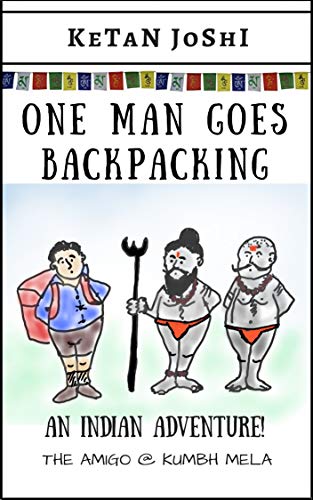
Review: One Man Goes Backpacking by Ketan Joshi


One Man Goes to Backpacking Ketan Joshi


Let the self-righteous, the patriots, the political hobos cool their horns in the ice bucket of Facebook. They have their political correctness. For the rest of us, there’s Ketan Joshi. I’ve been among the few lucky ones to have observed his meteoric rise as a humour travel writer. Started with the three-Amigos series. Now I have his recent book One Man Goes Backpacking. 3 Hours worth of pure, childish and nonsensical fun. That’s Ketan Joshi for you.

Humour’s next of kin is misfortune. The fun part of One Man Goes Backpacking starts when Ketan misses his train to Calcutta. A vendor suggests he should board a local train and chase the first train. Will he get it? That’s a whole different subject. Statistically speaking, the possibility is as thin as that of swatting down a mosquito in blind darkness.  Ketan goes to airport. His imagination brings up the disturbing picture of a journey in general compartment. It’s fraught with a series of misfortunes - scary, clammy and stinking of kerosene. The hilarious details make you go giggling. But if you’ve ever had the pleasure of journeying without reservation, you’d know they are terrible, revolting facts made edible with a pinch of humour.

Mosquitoes suck your blood but that don’t turn you into a vampire. History textbooks, cogs in a vast propaganda-wheel, suck your brain and turn you into a zombie. But One Man Goes Backpacking is not a textbook. Ketan Joshi minces no words, spares nobody. Dates and years don’t run along his pages like numbers on a cranky jackpot. They are stories, interspersed with Ketan’s own opinions and interpretations of them. To him it’s the story that matters more. History is about discovering the origin. Even bungee-jumping has an origin, a story. When retold by Ketan, history takes wings, flies high, then drops like a laughter-bomb.

The imperial hangover of Calcutta, the sleepy, surreal lakes of Sikkim, a pleasant elephant safari in Jaldapara, a strange second-hand bookstore in Bhutan, the bygone royalties of Cooch Behar, an excellent Assamese lunch at Guwahati – they are in the first part of this book. The second part is on Allahabad, Varanasi and the Kumbh. Ketan’s scorn for Bengali social skills and admiration for Bengali foods kept reappearing, the former more frequently than the latter. A rather longish retelling of the Puranic story of ocean-churning is resplendent with wittily crafted anachronistic dialogues. One Man Goes Backpacking by Ketan Joshi is the fascinating tale of a solitary traveller; it thrills and tickles you at the same time.


October 28, 2018

Review: Tom Pagdin, Pirate by E. J. Brady

Tom Pagdin Edwin James Brady
Download eBook
It was settled. When Tom Pagdin became the captain of a pirate ship, Dave would be his first-mate.

The two thirteen-year-olds escaped the tyranny of their parents to pursue a career in piracy. They didn’t have a ship. As the pirate crew, they had only each other. Tom had found a stray boat and had hidden it somewhere along the riverbank. The two runaways decided to escape in that boat. Before they sailed off, they accidentally overheard two mysterious men hatching a plan to rob a bank. Seemed like their boat had been discovered by these robbers, who now wanted to ‘borrow’ it for the occasion. After the robbery was carried out, one of the criminals stabbed the other and threw the body into the river.

Tom Pagdin and Dave Gibson, hidden behind a bush, watched it all. Little did they know, the murderer was none other than the vicious, French outlaw Jean Petit, who had escaped from jail, had sailed across Pacific in a small boat. George Chard, the bank clerk was unjustly accused of having involvement in the robbery. Would the two teenage pirates be able to save George? Would Jean Petit, who had walked his way over dead bodies of innocent men, manage to escape once again?

Tom Pagdin, Pirate by Edwin James Brady is a wonderful book that is sure to entertain both a child and an adult alike. E. J. Brady was an Australian poet educated both in the United States and Sydney. In his early life, he had worked as a wharf clerk, a farmer, and a journalist. His familiarity with the landscapes of rural Australia has its unmistakable impressions on the pages of Tom Pagdin, Pirate. The major characters of Tom, Dave, and Jean Petit were made alive mainly through conversations. Tom had a thick, Australian rural accent,
“Pick up your swag an’ foller me,” ordered Tom. “I’ll take yer right away.”
while Jean Petit spoke the sibilant English of a Frenchman.
“Ah! Zen vere shall ve meet – you an’ I, eh?”
Some, especially today’s mentors of creative writing, recommend against using dialectical dialogues. The cluster of apostrophes, misspellings – they say – distracts readers away from the plot. In a prose laden with conversations, they probably do. However, there is a certain advantage of this style; the readers don’t just read the conversation, they can actually hear the characters talking among themselves.

Readers will probably notice that there’s a hierarchy of characters in Edwin James Brady’s Tom Pagdin, Pirate. Importance was given to individual characters according to their roles in the main plot. Jean Petit, the uber-villain, was like a shadow of a predator lurking behind the thicket. He was nowhere, at the same time everywhere. He appears and disappears from the scenes, leaving behind him a trail of blood. Though his identity was not revealed until much later, his evil presence was felt right from the beginning. Tom and Dave, being the main characters, lead the story to its destination. George Chard though he was one of the many who benefitted from Tom’s adventure, remained in comparative obscurity. Jacob and Maria, the farmer -couple, in whose house Tom had stayed for a few hours, appeared on the scene and then quickly passed by.  A similar thing happened with the character called Hans Holterman, the wine-maker. He fell in the way of Jean Petit and was disposed of. Jean Petit’s kissing the knife after he murdered the poor old man, however, left its mark. Jean Petit’s total absence of conscience, his ruthless efficiency in crime, and his treacherous tactics made him a formidable adversary of Tom Pagdin.